28.2.15

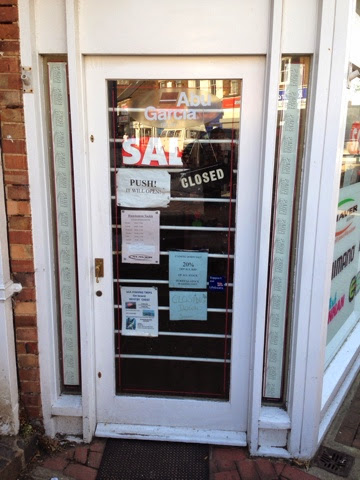
Push - It Will Open

Oh no it won't, you're closed!

Some wonderful signs in a shop door at a charming seaside resort.

It's the rather fantastic juxtaposition of "PUSH - IT WILL OPEN", and alongside "CLOSED".  That closed certainly suggests locks and bolts sufficient to satisfy and insurance company, and unlikely to be overcome by an encouraging push.

It's that ageing "PUSH - IT WILL OPEN SIGN" which does rather imply nobody really cares about getting it fixed, and making a better welcoming first impression.


7.2.15

For Discrete Assistance - Sound Horn

Here's a wonderful couple of adjacent signs on fuel at a local supermarket.  The first quite proudly announces "Service Call" which is "Discrete Disabled Assistance".  So simply "Ask, phone or visit our web site".  However, right underneath is a rather contradictory and very non-discrete instruction...the same disabled wheelchair, but this time adorned with "Sound \horn for Attention".

In reality it's about choices, but the immediate contrast here is super.


10.1.15

Disposable Bins


One of those delicate and tricky communications associated with the little room.  This is from the UK's second largest coffee shop chain.

"We would kindly request that customers refrain from disposing of nappies and sanitary towels down the toilet, and ask that you make use of the disposable bins provided."

So some confusion here about what are the "disposable items".  Here it's the bins which are described as disposable, rather than the items that they are intended to store.   In fact the bins are of course emptied and reused.   The point of the message  is really less about the nappies and sanitary towels themselves being disposable, and more about where and how to dispose of them.

Some further observations.....

- So high on the politeness....."kindly request, thank you", with a some gentile formality too "refrain" rather than "do not", and "make use" rather than "use".  

- It's a negative, if polite and congenial starting point, with "refrain from".  Rather than the specific positive request which would be about "please use the bins provided" for those disposable items.  

- Some mixed third person "customers refrain" which morphs into the second person with "you make use".

- It's a pride of place message - big, bright and prominent - although it's not a message which is targeted at everybody.  So the towels excludes at least 50% of the population, at least those who are male (plus the youngest and oldest females).  And the nappies excludes those without babies in tow wearing disposable (rather than washable) nappies. 

- And the reason for the message might help the call to action....which in reality is about not causing blockages.

So it's one of the distant HQ designed messages shipped out to operation shops.  With c.1800 Costa's in the UK it's a classic opportunity to it right at the start , so that when wheeled out 1800 times it's just more effective and engaging.  So if each of those shops is open for 10 hours, has one loo, each of which is used once every 10 mins, that's nearly 100,000 views a day, and 32 million views a year.  Technically 32 million customer engagements. 


And here are those "disposable bins".....
3.1.15

Red Man Shows

A delightful message from a swing bridge across a river in the west country.

"When red man shows wait HERE"

It's a natural development of the illuminated road crossing sign found at pelican crossings, here adapted for river crossing. So typically it's illuminated signs depicting a stationary red pedestrian for stop, or one depicting a walking green pedestrian for go or walk. [Although it could be argued that it's not definitively a male, and could well be moon dancing rather than walking].

Really it's about the "light" depicting a red man coming on.  The call to action is actually about stopping which can itself lead to waiting.   Although one may choose not to wait of course and go somewhere else.  So the message might equally be more explicit, something around....when red light shows stop here.  

So the reality it's about stopping here, rather than the more appealing idea that could be of man dressed in red showing himself at that location and in an authoritative manner.

6.12.14

Car Park Make Over

Here's a major regional shopping centre with a range of large and multi-story car parks.  Both the name and visual identification of the car parks is by its colour.  This is the Perkins Yellow Car par.  So here "yellow" has two roles - it's both a label (a single unique word) and a style at the same time.   Of course that label could be any unique word (monkey, spaceship, brick, smartie etc) or a number. 

The trick here is that the "label" yellow is also providing a visual clue in the word yellow, as we have a mental natural association with different colours.  So colour lables can be easier to remember because they are emotionally connected.  So it's not just a mental note but a sub concious emotional note too.  (Red tends to be physical, blue is intellectual, green is balance and yellow is emotional).

But it's now having a "makeover", and that usually implies some significant visual change, including some significant colour changing.   So if the colour changes, does the name need to change too?  Technically the "yellow" label could still apply even if the "yellow" styling changed.  Realistically, the originally helpful use of the single word for double meaning as both a label and a style would need to evolve to remain consistent.


29.11.14

Take Care on the Flat Stairs

The message here is helpful enough "Caution - Take care on the stairs".  But the words and the visuals do not align which can create some jarring.  So the picture is of flat ground, so more like slipping.  The picture would much suite a suit a message about being cautions on wet or slippery floors.

Double First Aid

At  a local garden centre restaurant...when one sign might  not be enough, use an exact duplicate alongside to re-enforce the point.

But lots of other revealing interest here too....

Firstly it's a message targeted at staff but it's a big message on prominent public display, and of course duplicated too. The design effort in creating an atmosphere and ambience for diners, can be somewhat diminished by this.

Secondly, there a curious tautology going on here.  It's a staff notice, telling staff that it's not for staff use.  So is it must be for public use.  But the notice's target audience is staff  - given the clear 'Staff Notice ' header. So if you're a member of the public, despite the prominent public and duplicate display  it's not for you.

Thirdly, the definition of "use" in this case can be seen three quite distinct ways ways.  Either it's use of the first aid items by the staff for their own injuries.  Or it's the use of the use of those items by the staff for customer injuries.  Or it's the use by customers for their own injuries.  In practice it's the middle one of course - that's the whole point of having a first aiders.  The sign's really about discouraging the use by staff for their own injuries.  There'll be a separate staff first aid box with different things in - for example different colour plasters for use by staff to ensure their injury is prominently treated. 

The reality here is that the sign's a substitute for something missing around staff policy, training or awareness. There's a fair chance that perhaps one member of staff once used something from this first aid kit for their own care.  But the corporate reaction rather than being targeted and specific id generic - duplicate signs targeted at all staff on display to all customers.   

22.11.14

Follow the Footprints

Here's the sign for a local after school club.  

To find find the club, simply follow the footprints.  That might be more tricky than it seems. 

Firstly the footprints are not in the floor but on the wall.  Secondly they go in all directions, left, up, right.

In fact the footprints that are being refereed to are ones that were painted on the ground, but have since been worn away.  A subtle arrow might just help, without detracting from the jolly footprint theme.


8.11.14

Nice No Entry

Sometimes less is definitely more.

Here's a lovely example.  A sufficiently obvious, clear and simple sign.

No need here for barriers, cones or ropes, just a clear official message.  It also sends a message of trust - there's no physical barrier, in fact it's not even in the middle of the path.  And being bestowed with trust just might make it more difficult to betray that trust by contravening the message.


Door and Tap Instuctions

Even some of the most everyday activities get the sign treatment.   Here's a great example of how to lock a door and then operate a tap.

To be fair, it's a farmhouse that's very kindly hosting a ticketed charity event.  So the what would ordinarily be a private loo becomes a public loo.

So instruction for locking the loo door does play to that need for confidence that the loo can be secure and private.

"TO LOCK THE DOOR
Please push handle upwards
then turn the knob to the right

To UNLOCK
Turn door knob to left"

There's a rapid transition here from polite and full in the first half (please...turn the knob to the right) to a much more direct and abbreviated second half (turn door knob to left)

And then for the tap instruction.  Taps are increasingly blending from with function.  Sometimes the form can make the function a bit difficult to fathom at times.  For example the increasingly common stick mixer tap - where you need to control not only the balance between hot and cold bit also the flow.   So which way do you move the single lever.....forwards and backwards and left and right.  Anyway, this has been properly anticipated here with the message
"TO OPERATE TAP
PULL LEVER TO THE RIGHT"


18.10.14

Reserved for Bicycles

Cycle "parking" can be described in may different ways.  Often the simple presence of some racks can be enough.  Here's a rather charming version for a rack and roof structure.... Rather like a restaurant reservation, this area is "reserved", and not for cycles, but the more formal "bicycles".

11.10.14

Press What Red Bell Button?

Here'a an intercom system.  So it's the front door first impression.

So what to do.....There's a camera for starters, so someone might be watching.

But what button to press.  Maybe you get spotted on camera and get a welcoming voice over the intercom.  But more realistically it's working out what button to press.  You're naturally drawn to the biggest button, right above the speaker that also happens to have a green marker.   But then there's some instruction, although quite low down...."Please press the red bell button".  Well there's no bell button, but there is a button with a red circle on...is that the one they mean?  Red is not the most positive and encouraging colour for these circumstances either, typically used for emergency buttons like fire alarms.  The the red dot is probably the closest match to the instruction.... let's go for that.

In reality, the red sticker seems to have been added over the bell picture as with all the pressing the colour had warn away.  But you're left with a test to enter.

What's extra curious about this is that it is the entrance to an organisation that provides arbitration services and hires out rather nice business meeting rooms.    So as a hiring customer it's creating an impression already with a test/challenge/barrier, do they really understand my needs.  And what about those arriving for arbitration, creating initial barriers or angst at the moment of arrival is probably not the best start to proceedings.


4.10.14

Exit Exit Exit Exit

Here's a new car park.  The exit can be approached from three main directions, all of which converge at this single corner point.  That means the signs have to work from three different directions which creates a rather intense and slightly disconcerting arrangement as you you travel through. 

20.9.14

Any Assistance?

It can be tricky to get the signs right in loos.  Here's the double bonus from a national coffee shop chain.

1. So "Please pull cord for assistance".  But what sort of assistance is reasonable.... where to draw the line.... That sign is intended to be associated with the emergency pull cord of course, but is off the side.

2.  And "Please only put toilet tissues down the toilet".  That's to discourage things like nappies which cause blockages.  But the word "only" clearly restricts anything other than tissue.  Surely the purpose of the visit to the small room is to provide some surplus body output for the pan......so what to do with that if the only thing that can go down the loo is toilet tissues?

Reserved Coucil

Each organisation will have it's own approach to risk, some even formalise and articulate their "risk appetite".  That includes our public sector statutory authorities, which given the public money being spent, can encourage some natural risk aversion.

So when we see "Town Council Reserved" it might well be interpreted as a statement of risk appetite.  It is really intended to refer to the parking alongside of course.   It's really just a wide flagstone pavement and there's no parking bay marked, so with no other parking hints, it does rather teasingly encourage that wider sense of "reservation".


9.8.14

Need to Notice


As if 'No Smoking' is not clear and well established, this notice one has an extra and rather polite plea to adhere to that no smoking message.

2.8.14

Cleanliness

Here's a sign which is positivity encouraging cleanliness.  However the sign itself is itself rather dirty.  So it's not setting a standard, default or visual expectation.  It's an authority statement which attracts interest and attention but the visual clues are at odds with the message.

26.7.14

Respectful Recycling

Some simple please and thank yous can really help set positive, polite and engaging tone.  Here for some recycling bins.  A less formal font for the please and thanks yous too.


20.7.14

Solo Motorcycles Only

Some dedicated London parking for 'solo motorcycles only'.

Given that the alternative to a solo motorcycle is a motorcycle with a sidecar,  and motorcycles with sidecars are so rare, then the word solo is rather overprescriptive, even superfluous.  

Also, most solo motorcycles can carry a pillion passenger.  Technically that would make them no longer solo.  So motorcyclist and passenger, just as with a sidecar.


19.7.14

Properly Private Property

Some lovely old and substantive 'Private Property' signs adorning the edge if a public footpath across a meadow.  Super three dimensional signs cast in metal, and have stood the test of time.